Showing posts with label Europe. Show all posts

Wednesday, August 5, 2009

Daily quickie: BARcelona

Months in Barcelona meant multiple late-night outings. Each evening was an adventure, checking out ultra cool hangouts and bars with awesome vibes. While divulging too much would be sure to spoil my fond memories, here’s a taste of Barcelona’s finest bars.

Chupitos (c/ Aribau, 77, Barcelona): This narrow, black-light-lit shot bar is always a party, bustling with locals and tourists from midnight to about 3 a.m., when the place clears out as party-goers make their way to the clubs. The specially trained bartenders at Chupitos specialize in making sugary shots for 2 Euros a pop. Large menus on the wall list hundreds of names, and though the names don’t say what the shots contain, it’s fun to pick a name, push your way to the bar and just go for it.

Some shots, or “chupitos,” are lit on fire and served with marshmallows that you roast before taking the shot; others are served with whipped cream on top; and yet others taste like super-strong mouthwash. There are even some “dirty” shots. My favorite was the Harry Potter with a flaming orange and all. If you’re lucky, and if you go often enough, the bartenders will even create shots just for you, like my favorite bartender, Raul, did. Chupitos is guaranteed fun.

Pipa Club (Placa Reial 7, Barcelona): This is a secret club in Plaza Real off of the famous La Rambla. Passers-by would never notice it, but those “in-the-know” know to ring the doorbell, climb the narrow stairs and be escorted into this secret jazz club with live music and strong drinks. Pool tables and couches add to the underground feel. It’s the perfect place for a chill night and a very local hangout.

Bosc de Les Fades (c/ Passatge de la Banca 5, Barcelona): This bar, a part of the wax museum off of La Rambla, is a sight to be seen. Meaning “Forest of the Faries,” this rather large lounge gets jam-packed and is decorated to resemble an actual forest. With tree stumps to sit on, leaves hanging from the ceiling and, of course, wax sculptures, the bar and its dim lights transport you to a magical place. Though it tends to attract mostly an older crowd, Bosc de Les Fades serves delicious sangria. A major plus – for Americans, that is – is that there is no smoking allowed inside because of all the wax decorations (It’s nearly impossible to find a bar in Barca that doesn’t allow smoking!).

La Oveja Negra (c/ Sitges 5, Barcelona): In one word, this basement-y bar is awesome. A five-minute walk from La Rambla, this tavern requires that you pass through a bouncer who looks like Hagrid from Harry Potter to enter the spacious basement equipped with foosball tables, high-tops with standing room and low tables for sitting with friends. More is definitely merrier here. Beer is ordered in pitchers to share, as is the sangria. Oveja Negra’s sangria is by bar the best in all of Barcelona – thick and syrupy, without fruit, and destined to give you quite a buzz. Be careful to watch your purse in the bar, though, because thieves target this popular place.

Dow Jones (c/ Bruc 57, Barcelona): At this touristy bar based on the Stock Market, the prices of the drinks rise and fall based on how many people are ordering them. Every half hour, the market crashes and all the drink prices fall. It’s really more of beer-drinkers bar, with only a few mixed drinks on the menu, but it’s fun to frequent for a relaxed night or before going out to a club.

Bar Marsella (c/ Sant Pau 65): This historic absinthe bar was opened in the early 1800’s, so in essence, it is a living museum. The gritty, grand room that makes up the bar has wirey tables and boisterous guests. The bar sells cups of absinthe with cubes of white sugar and a spoon, so that you can burn the sugar onto the spoon and mix it into the licorish-y alcohol. For those who are sissies, the bar also sells bottles of water to dilute the powerful taste of this liquor that gives this saloon its claim to fame.

Any bar on Carrer de la Mercé (Barcelona): This street is home to many little cocktail bars, but all specialize in “leche de pantera,” or the panther’s milk. This thick, alcoholic drink combines milk, gin, rum, peppermint and cinnamon for a tasty drink reminiscent of eggnog. Definitely worth trying for a local taste.

My end of the date rate the plate: While these bars don't serve any food worthy of good forking and spooning, they do deserve one heck of a big gulp!

Tuesday, July 28, 2009

Amsterdam: Pancakes and Poffertjes

Some call Amsterdam "Venice of the North." With hundreds of windy canals, wobbly buildings, narrow staircases and tons of biking, it’s no wonder it’s easy to work up a hefty appetite. On just about every street, “munchie food” is sold. From chocolate-dipped waffles and hot French fries to frosted doughnuts and slabs of cheesy pizza, this city does fatty food right.    

During a February trip to Amsterdam, my travel buddies and I were told not to miss The Pancake Bakery, located just about a block away from the Anne Frank House. After a little sight seeing, the three of us made our way to this homey pancake joint. Our large midday appetites kept our eyes bigger than our stomachs as we ogled the menu.

Sweet and savory pancakes, filled with bananas, strawberries, warm cherries, Nutella and raisins appealed to me, though I am sure if I had had breakfast I might have been interested in pancakes filled with lamb, fresh bell pepper and garlic or tomato, cheese, basil and pesto.

When a rather large plate was walked past us, the sugary smell was overwhelming, but I knew there was no way I could ever order the traditional pancakes. Instead I turned my attention to the children’s pancake list and ordered the kiddie-sized pancakes with bananas and powered sugar. The one large pancake stuffed with chunks of fresh banana and doused in messy powdered sugar was practically the same size as the regular-sized pancakes my friends ordered, and, of course, tasted just as scrumptious.

But Holland is known for their Poffertjes – tiny pancakes that are made with much lighter batter and are typically flipped in their special cast-iron cupcake-like pan before one side finishes cooking. I convinced the guys to split an order of these little delights with me. Being a raging chocoholic, I selected the Poffertjes with chocolate sauce.

Between my two friends and me, the mini Poffertjes were gone within five minutes. We all agreed we should have split a few more orders instead of eating our individually ordered pancakes. Not only is Amsterdam a sinful city, but its food is scrumptiously sinful too.

KP’s Crumbs: Poffertjes are worth every calorie. Bring some loved ones to The Pancake Bakery and split a few orders of different types of Poffertjes. Resist the urge to order pancakes, and I can promise that everyone with a sweet tooth will surely enjoy. Plus, if you decide you want more, the chef can quickly whip more up.  

My end of the date rate the plate: The Pancake Bakery’s Poffertjes are to die for. Heck, the bite-sized babies are so good, you might even want to fork and spoon them on the street. But don’t worry, that’s probably legal in Amsterdam.        

Thursday, July 23, 2009

King of all markets: La Boqueria


From January to April of 2009, I spent my way eating through Europe. Though I was based in Barcelona to study and perfect my Spanish, I was at the crux of rich, flavorful Mediterranean fare and a hub for quick, relatively cheap plane rides to the rest of Europe’s delicious offerings.

In Barcelona, I savored homemade Catalonian cuisine and spent my days gallivanting around the city in search of Mom-and-Pop cafés, fancy dinner-date locales, after-hour eateries, picnic-worthy marketplaces and open-air markets. While nearly every place I ate in conjured up thoughts of a long-lost American counterpart, I could not imagine anything even remotely comparable to Barcelona’s most famous food market, La Boqueria off of La Rambla (arguably the most famous street in all of Barcelona).

In the United States, we have traveling and stationery markets, bazaars and the occasional festival. NYC has its weekly farmer’s market in Union Square; LA has its farmer's market. But all too often, American open-air food fairs are cluttered with crafts and flowers. While these artsy goods are beautiful to say the least, they outshine or take away from the food itself.

At La Boqueria, this is not the case. The food is an art form. It’s inspirational. From the cold fruit juice and rich candy to the picture-perfect fruit displays and meat still on the bone, La Boqueria is, by far, the most awe-inspiring market I have ever been to. The colors, the smells, the touches, the sounds and the tastes entice all five senses. The vendors, who set up and tear down every single day, take pride in the presentation of their stands – for if they didn’t, the competition from the other vendors would surely steal their business. Though many local Catalonians make daily trips to the market to purchase the freshest ingredients for their meals, even those who hate to cook or don’t have access to a kitchen will enjoy walking around.  

The market is divided into sections. The fruit and vegetable vendors are all close together, just as the meat sellers, the fish and seafood personnel and the cheese specialists are. Some give samples in order to snag their customers. Some chant to attract tourists. But everyone yells orders across the way. The liveliness is contagious.

In addition to the sellers’ stands, there are also a few walk-up restaurants that prepare paella, Spanish tortilla, bread with tomato and fried seafood using only the fresh ingredients from the vendors at the market. On any given day, locals take a seat at the bar, eat lunch and return to work. Of course, the places with the longest lines are considered the favorites, and typically they have the best food. The prices tend to be a bit steep (about 17 Euros a person), but the ingredients and fish are fresh and filling.    

There are only a few downsides to La Boqueria. It opens early (by Barcelona standards, anyway) at 8 a.m., and it closes by 3 p.m. Most of the vendors only take cash, and they prefer for you to speak in Spanish or Catalan (don’t let them fool you though, nearly everyone can speak English). Lastly, the fish and meat sections of the market can be a bit unappetizing if you lack a strong stomach, but at least you can be sure it’s all fresh.  

After spending time perusing the market, you can cruise La Rambla (the famous street), which hosts a variety of floral vendors, street performers and artists on its center walkway. I can certainly attest to the fact that there’s nothing as good as walking along La Rambla on a sunny day while enjoying some fruit from La Boqueria. It’s an experience you don’t want to miss.    

KP’s Crumbs: If you are ever in Barcelona, La Boqueria is a must. But be sure to get there before 3 p.m. or else the gate will be closed and you’ll miss all of the action and great food. Sip on an icy mango juice for 2 Euros and pick up a container of assorted fresh fruit to taste how sweet all fruit should taste.

My end of the date rate the plate: Worthy of multiple forkings and lots of spooning. You may even find yourself craving more.  

Monday, April 13, 2009

Italy knows good eats

Spring Break. The time in every girl’s life that she must starve herself for a week or two or even three before daring to strip down and frolic in the sun with friends. Though she knows it’s merely impossible to lose the unwanted flab in such a short amount of time, it’s inevitable that she will skip the chocolate croissant, the whole milk in her coffee and the other half of her Manchego-cheese bocadillo. Where the trouble comes, though, is when she knows she is going to Italia, where the word food is synonymous with carbs and chocolate, and the idea of steamed or grilled vegetables is as laughable as genuinely expecting to see the Pope while touring the Vatican.

While a crash diet the week before break seemed promising, in hindsight it seems foolish. The smooth gelato beckons, the steamy, frothy cappuccino calls, the Chianti and Prosecco promise to get you buzzed, and the pasta – oh the pasta, in all shapes and sizes, but always al dente – will get you every time. Period.             

Since I had no idea what to expect from Italy, I dismounted the plane in hopes of finding some spaghetti with meatballs, chicken parm, garlic bread and fettuccini alfredo. Well, I’m “alfred-o” not.

Of course the long, round noodles that I know to be spaghetti exist. And yes, there are meatballs. But together? No way. As hard as I looked, for the life of me, I could not find the staple American-Italian dish. As for garlic bread, turns out Italians have simple breadbaskets with dry, stark-white bread and prepackaged breadsticks. Waiters will look at you strangely if you ask for a plate so you can dip your bread into olive oil with pepper or balsamic vinegar. They do, however, love to put oil and vinegar on their salads…which they eat after dinner. They say it helps with digestion. Why yes, of course this makes sense, I thought to myself. After an entire plate of alfredo (the thick, creamy, heavenly sauce that no one, no matter how skinny, should be allowed to eat), the Italians are going to need something to keep it from sticking to their insides. Oh wait. Italians don’t even know what alfredo is. So much for that idea. But, no worries, Italians get their fat from a whole plethora of other deliciousness that I didn’t even know existed.

Italians would rather sink their teeth into “spaghetti carbonara”, or cream, egg and cheese atop of a hefty plate of pasta. Though I never ordered it, I did snag a bite from one of my travel buddies. Other staples in the Italian diet included spaghetti with cheese and pepper and spaghetti with tomato sauce and bacon. Pesto was impossible to find in Rome, but delicious in Venice. Gnocchi and tortellini in Florence were heavenly. And the pizza, which doesn’t come in round pies, but rather in long, rectangular ones, was pure ooey-gooey sin.

On my day trip to Pisa, the boys who traveled with me and I stopped in a pizza joint, where the waitress chopped the pizza and then weighed it to give it a price. I chose the veggie pizza with fresh zucchini and tomatoes, and my slice (or better yet, my slab) was less than 2 Euros.

As I was walking away, a grungy man appeared from the back with a plate of deep-fried balls the size of baseballs. How could I resist? I ordered one to split with my travel guys (they are always hungry, even right after they eat!) as the man explained to me they are called “arancini,” or little orange, because of their shape like the fruit. It was filled with rice, peas, tomato sauce and meat. I was content with my decision to try one, and I am certain the boys loved me even more for overfilling their tummies.

Every morning (and sometimes in the afternoon) I would sip on cappuccino – another newfound love of mine. I thought I had tried the best coffee in the world in Spain; however, the Italian cappuccino really gave Barcelona a run for its money. When walking by the Pantheon in Rome, I spotted a yellow sign that read “La Casa del Caffee, Tazza d’Oro” (Via Degli Orfani 84). Craving something cold to wake me up, I stopped in and ordered an iced cappuccino, not quite sure if such a drink existed. The man at the register mentioned something even better, called a “granita di caffe,” and rung me up for 2.50 Euros (a pretty steep price for even a coffee addict like myself, but I needed coffee so I paid without contesting). I took my ticket over to the barista (if that’s what you call him) and he dug deep into a slushy cooler to fill my cup with literally iced espresso. He filled the rest of the cup with cream and whipped cream, and then sent me on my way with a straw as if this coffee were a mere espresso shot. It was, however, nothing short of tasty perfection. Sweet cream mixed with bitter coffee – any chocoholic/coffee lovers delight.

As you would expect, God’s gift to the world comes in dessert form and it consists of gelatotiramisu, cannolis and Italian cookies. While you’d be hard pressed to find bad gelato, my favorite was from a neon-colored store in Florence, where the line went out the door. Every color and every flavor were piled high behind the glass encasing in metal containers, and when mixed together in a cone I thought I had gone straight to heaven.

In Rome, I was determined to find biscotti. Chocolate-chip, melt-in-your-mouth biscotti. I was told Trastevere has the best food in all of Rome, so when wandering with the boys, I found “Biscottificio Artigiano Innocenti,” (Via della Luce, 21, Trastevere, Roma) an Italian hole-in-the-wall, family-run bakery. The cookies galore were filled with jams and jellies and fruit and gummies and nuts, but my favorites were the horse-shoe-shaped, crumbly ones dipped in chocolate. My notion of chocolate-chip biscotti, the owner told me, should be dismissed just like my notion of spaghetti and meatballs.    

The conception about Italy that did hold true was the loud, jovial, big family, wooden table mantra. In Venice, the boys and I ate at a local trattoria and happened to have walked in a man’s 83rd birthday party. The red wine flowed freely, the speeches kept coming and after singing the Italian version of “Happy Birthday” to present the tiramisu cake, the 30 guests started signing what seemed like every Italian song under the sun. Like a Christmas sing-along. Italians really do know how to throw a party…or the alcohol is just that strong.    

My favorite meal took place at “Il Gatto E La Volpe” (Via Ghibellina, 151) in Florence, where I managed to meet up with a childhood friend and some other friends I made in Barcelona who were also traveling in Italy. It felt like a very merry un-birthday party for me, since I was the only person bringing everyone together. With this motley crew, I learned to always choose wine over water (even if it makes me a tad tipsy) and I tried the sweetest, yet most tangy aged balsamic vinegar I have ever eaten. After salad and pasta and an irresistible bite of chocolate cake that one of the boys ordered, I went home with a food baby forming in my stomach and a smile on my face because Italy knows good food and good company. 

Monday, March 23, 2009

Some days

Some days you wake up and you know. You immediately start to worry. Nothing in particular is wrong. You just feel like the forces had been aligning when you were sleeping and there’s something brewing. Today was one of those days.

Though I had every good intention to go to class all day long, Monday is my longest day. Class straight from 11 a.m. to 7 p.m., sin pausa (without a break), and I awoke without my usual fervor. I showered to wake myself up and I listened to Spanish guitar on my iPod during my 45-minute hike to school from my apartment, in hopes that I would feel like my typical, eager self, ready to seize the day. No such luck.

By the end of my first class, Spanish, I was half falling asleep. My second was so painful that I began to bargain with myself in order to keep my eyes open. The idea of focusing was more of a joke than a reality. When my third class rolled around my heart was begging my body to bolt, and the thought of a fourth class made me nauseous. The snip bits of class I did catch in between my heavy-lidded blinks weren’t making it easy for me to sit still.

In Spanish, we reviewed grammar and prepositions. As always, my professor had us play games as memory aids and today, she had us create sentences about our dreams – the dreams of our childhood, our current dreams and the dreams we have for our futures. While students in the class elected to write about their desires for 10 cats, to become ballerinas or to have a small house with flower-filled terraces, I chose a slightly less superficial approach. The sentence I wrote to read aloud was: “Ahora que tengo 20 anos, sueno con disfrutar mi vida cada dia,” or “Now that I am 20 years old, I dream of enjoying my life each and everyday.” [Thought to self: Great KP, good thing you are stuck here in this classroom.]

My second class, Comparing Media in Latin and Anglo-Saxon countries, preached the growing role of the Internet for media sources. One of the pluses (or to some, the negatives) of the online world is the ability of the reader to customize the news he or she chooses to receive. We read a New York Times article called “The Daily Me” about how mass media is becoming individualized media because people’s intentions these days are more selfishly driven and they only want to read what they chose. [Thought to self: Go ahead, KP, be selfish. It’s the direction of the world.]

My third class, Advanced Spanish Oral Expression, consisted of my class playing a game about the history and “gems” of Barcelona. Because I have been just about everywhere in this city and have gone on at least ten tours (some guided by professionals, some guided by my guide books), I knew just about all of the answers. [Thought to self: Well KP, you wouldn’t have won the game if you didn’t explore and ask questions to waiters, policemen and locals on the streets.]   

So for once, I decided to apply what I learned in school: Today was going to be all about me and me alone; I was going to enjoy the day to the fullest; I was going to discover some new gems. After this past weekend of exploring the little streets in Gracia, biking along the beach at Barceloneta and randomly hoping on a Renfe train simply to get off where my friend and I felt like it, I was itching to get out of the classroom. Fourth class, Society and Politics of Spain, simply didn’t stand a chance. So I walked out. Out of class. Out of the building. Out of campus. And I decided to explore Barcelona by my lonesome just for the fun of it.

I took the Metro to Jaume 1 and began to walk. I walked down every single street that I wanted, without having to ask anyone if they minded. I found a beautiful store called IVO & Co. that sells kitchen goods, a coffee shop called La Clandestina, whose boho feel inspired me, and then I found Caj Chai (pronounced Chai Chai) – a tearoom unlike any other I have ever been to, whose hip drum music in the background was matched only by its young, avant-garde clientele.

Caj Chai’s dim lighting was sexy, the stonewall along one side of the narrow café had character and the loud chatter produced by the guests told me immediately that this was nothing like the tearoom you find in England. 

The mix-and-match rattan chairs coupled with high tables and low tables and bar stools provided a yard-sale-inspired atmosphere, and the twinkling Christmas lights hinted at a majestic air. The menu, enveloped by flimsy bamboo, offered a lengthy list of teas – from China, Japan, India, Korea, Nepal, Russia, Taiwan, Morocco and Turkey, with every flavor and color imaginable. With so many choices, I asked the waiter for some suggestions – something sweet with natural sugar, something with no milk added and something a little fruity. He and I selected a black tea from China with leeche nuts.

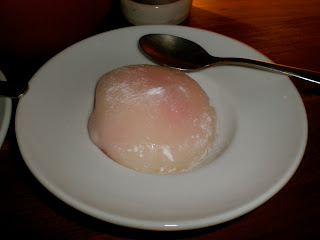
 For the fun of it, I also questioned him about the interesting looking desserts. I told him I wanted to try something I had never tried before and so he brought me “daifuku con fresa y nata,” or “daifuku” with strawberries and cream. Turns out this delicacy is a Japanese dessert made from very sticky rice, called mochi, jacketing chunks of strawberries and sweet cream. And though the consistency was something like a really soft, incredibly sticky gummy bear, it was absolutely delicious and the perfect pairing for my tart tea.

After a few sips followed by a few bites, I decided it was time to reflect. I believe today marks a milestone in my life: KP’s first day of “playing hooky”….ever. And while I would love to say it was my first and last, I’d be lying.

Some days the forces are aligning. You’re inspired to do or become something. To get up and go. To explore for the sake of exploring. To get lost because you can. To eat for the sake of eating. To sit alone in a café. To escape from the world for a split second. To write.

Today was one of those days. 


Sunday, March 22, 2009

Sugar and spice and everything nice: La Nena

There comes a time in every girl’s life that she gets sick of Catalan and Spanish food. Not because it’s not flavorful (in fact, it is) and not because there aren’t enough choices (between Iberian ham, Manchengo cheese, tortilla esapana, bocadillos galore, calcots, tapas and croquettes, I’ve got plenty), but simply because she can’t escape it. And as much as I tried to avoid it, it happened to me three months in.

To break the routine of Spanish food, I invited Irena to join me for crepes in my absolute favorite part of Barcelona, a little district called Gracia. Gracia boasts chic, one-of-a-kind clothing stores, precious apartment facades, plazas with playgrounds and the best part: unique restaurants owned by locals. Though I had only walked by the storefront of the creperie once, I made a mental note to myself that I would need to return. As Irena and I wandered off of the Metro, I had not the slightest idea of where the restaurant was located, just the faint memory of a worn-down sign. By some miracle, Irena and I walked directly up to it. Though the lights were on, a man was mopping and the door was locked. So much for crepes.

But then I remembered a seemingly adorable café off of a plaza that I had strolled by once. Destined to get away from Spanish food, I swindled Irena into walking around yet again without a definite location, just an inkling.     

And then I saw it - La Nena, with its chalk-written signs outside and child-sized, brightly colored wooden chairs welcoming me to come in. If ever a name were to be a perfect fit, this would be it. “La Nena” literally translated means “the baby girl,” and this hidden café was everything that a baby girl should be: lovable, rosy and engaging and above all, her aura should make you smile. La Nena was like a sweet dream brought to life.

Its entire existence is based on an infantile spirit, as if Mother Goose herself were to have opened it. The old-fashioned wooden shelves lined with fresh, loose-leaf tealeaves in glass jars resembled a traditional apothecary. The artwork adorning the walls were hand-painted and hand-written. My favorite was the rather large sign that read (in Spanish, of course), “No alcohol served here.” The wooden piano in the main dining room had music books sprawled across it and the bookshelves in the candy-colored backroom were full of antique books about chocolate. I felt as though I had been invited into someone’s playroom for a cozy meal. And what better to serve at a snack bar called The Baby Girl than sugar and all things nice? Perfectly in tune with its character, La Nena serves chocolates, pastries, hot chocolate, teas, coffee, infusions and light meals. Better yet, it only uses organic ingredients.   


To begin, I ordered my typical “cortado” – or an espresso cut with a dash of milk. I have found that fastest, most accurate way to decipher if a restaurant, café or bar is worthwhile is by trying the coffee (Spain really does have the best in the world, I am certain). My cortado not only came in a warm, white porcelain cup, but it was served with a homemade, crumbly galleta (or cookie), sort of like a rounded, ginerbready graham cracker. Dipped into my coffee, it tasted simply scrumptious.


Perusing the menu made my mouth water and eventually I was able to narrow down my choices to two: vegetable couscous or quiche. With the help of my waitress, I selected a wedge of zucchini quiche served with an organic salad. The quiche’s thick and buttery crust was rivaled by the egg, the chunks of fresh zucchini and the strong layer of cheese caked on top. The salad accompanying it was much lighter and consisted of tomato, cucumber, olives, carrots, lettuce, parsley and small squares of cheese. The dressing on the side – olive oil and honey vinegar – added a hint of sweetness. Because the food was rich and heavily saturated in and with flavor, I felt the need to take small bites to savor it. And so I did.


The café’s air of innocence and childhood happiness made Irena and I giddy, talking like little girls, planning our fairy tale weddings to boys we don’t even know exist. Pure delight. How apropos: I shoulda guessed that a chocolateria called “The Baby Girl” would be my most favorite hole-in-the-wall gem in the entire world.